
Enshittification Has a Sister (And She's Squatting in Your Content)
Why AI isn't the true villain (and what actually is)

Cory Doctorow handed us half a diagnosis and we threw a parade.
Enshittification. Ugly word for an ugly thing. Perfect autopsy of how platforms rot from the top down. Facebook buries your actual friends under a mountain of ads and suggested posts from accounts you’ve never heard of. Amazon hides the thing you searched for behind seventeen sponsored results, three knockoffs, and a prayer. Google serves you SEO garbage written by content farms that technically answer your question in the same way that a vending machine sandwich technically qualifies as food.
Platforms decay. They squeeze users until the users leave. Then they squeeze harder because the quarterly numbers demand sacrifice. The whole thing collapses eventually because you can’t extract value from a corpse forever. (Though God knows they’ll try.)
Doctorow nailed it. The term spread because it named what we’d all been feeling—that slow, creeping sense of everything getting worse while the people responsible posted record profits.
But here’s what’s been gnawing at me.
Enshittification explains why platforms degrade. It doesn’t explain why every piece of content you scroll past looks like it was written by the same ghostwriter who charges by the template. (He has six. You’ve seen all of them.)
That’s a different disease entirely.
The Rot Rising From Below
While the platforms have been busy squeezing us from above, something equally sinister has been bubbling up from below.
Open LinkedIn. I dare you.
(Actually, don’t. I’ll take this bullet for both of us.)
Count the posts that start with a one-line hook followed by a dramatic paragraph break. (You know the format. You’ve probably used it. I definitely have.) Count the “I was sitting in first class when the flight attendant taught me everything I know about leadership” parables. Count the carousels that all look like the same person made them. (The same person probably did. He sells a course now.)
Now open YouTube. Count the thumbnails featuring a human face frozen in an expression of shock so exaggerated it looks like they just discovered their identity had been stolen by a circus clown. Mouth agape. Hand pointing at something off-screen. Red circle highlighting nothing in particular.
Open your inbox. Count the emails that promise “3 secrets to [X]” followed by a countdown timer that’s been counting down to the same deadline for six months. (The urgency is eternal. The deadline is a lie. Nobody’s fooled. We keep clicking anyway.)
This isn’t platform decay. This is something else.
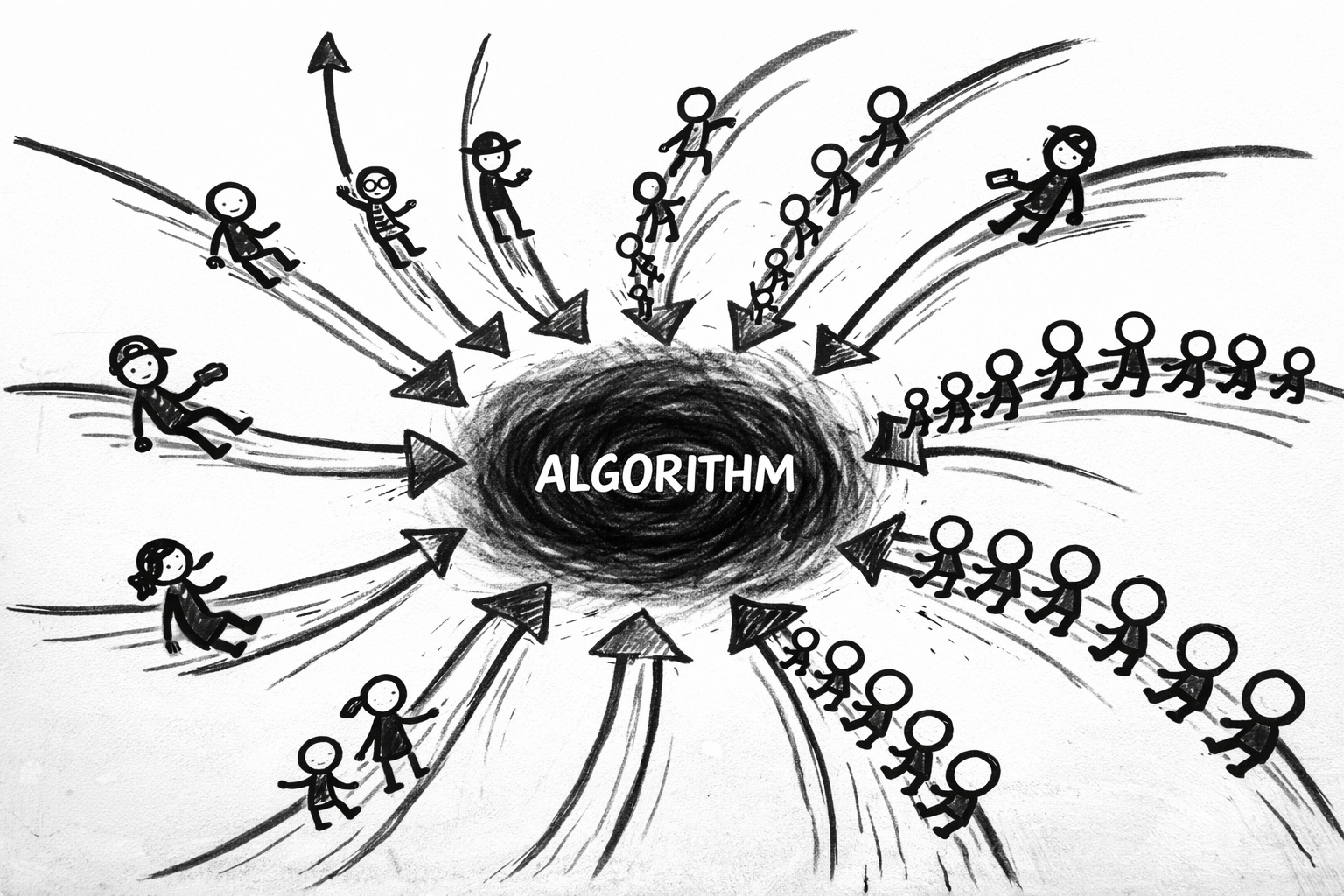
Millions of creators, each making perfectly rational decisions in isolation. Chase the algorithm. Copy what works. Study the templates. Reverse-engineer the viral post. Rinse. Repeat. Rinse. Repeat. Rinse until your fingerprints have been scrubbed off entirely and your content could’ve been written by anyone—or anything—or possibly no one at all.
Not coordination. Not conspiracy. Just gravity.
Everyone independently optimizing toward the same center.
I’ve been calling it ensloppification.
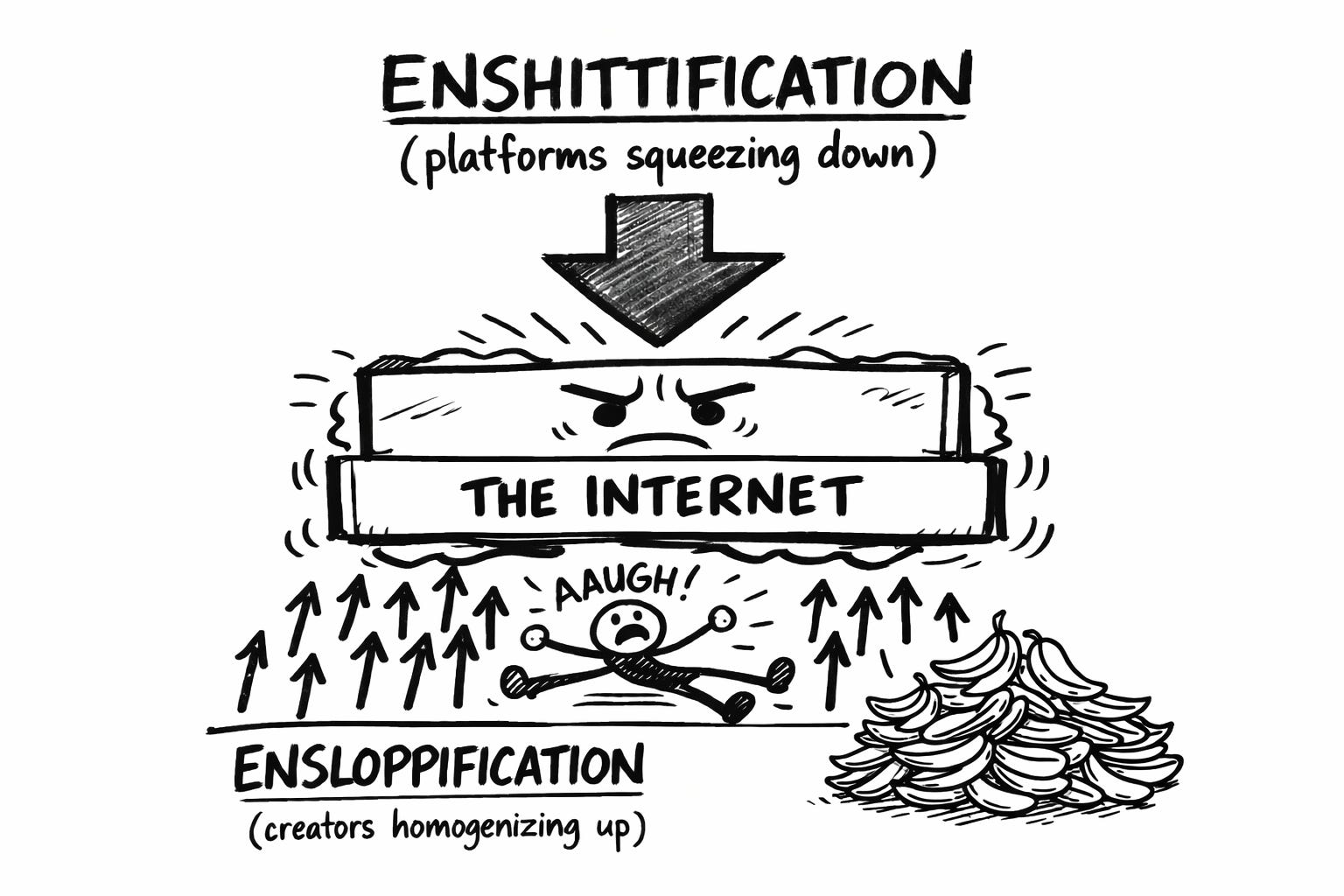
Enshittification squeezes from above. Ensloppification pushes up from below. And the internet?
The internet is being crushed from both directions at once. A trash compactor with walls closing in from every side. We’re all just Han Solo looking for the off switch.
“But Nick, AI Ruined Everything”
Here’s where I lose some of you.
AI didn’t cause ensloppification. AI just removed the last remaining obstacle: effort.
The slop was already there. We were making it. With our own hands. Our own keyboards. Our own desperate need to be seen by an algorithm that’s never going to love us back no matter how many hooks we craft.
Consider what was already happening before ChatGPT showed up and started writing blog posts about productivity tips while hallucinating statistics:
SEO keyword stuffing that made articles read like a robot having a stroke mid-sentence. “Best practices” that became identical practices because someone wrote a book about them and everyone bought it. (Then everyone wrote the same book. Then everyone bought those too.) LinkedIn story arcs copied from the same viral post until the “I was fired and it was the best thing that ever happened to me” genre became its own content category. YouTube creators saying “without further ado” and then providing several more ados because the mid-roll ad won’t unlock until minute eight.
The webinar formula. God, the webinar formula. Fifteen minutes of value you could’ve gotten from a TikTok, followed by forty-five solid minutes of hard selling, and a “limited time offer” that expires never. The tripwire sequences. The lead magnets that are just blog posts disguised as PDFs because apparently slapping a different file extension on something makes it more valuable.
(It doesn’t. We all know it doesn’t. We keep doing it anyway.)
The convergence was happening. The gravitational pull toward sameness was warping everything. Every piece of content slowly drifting toward the statistical average of all content.
AI just strapped a jetpack to it.
Now you can produce ten versions of what’s trending instead of laboriously crafting one. You can deploy “proven frameworks” without engaging a single neuron. You can scale your mediocrity to industrial levels, flooding the zone with content that technically exists but doesn’t actually say anything.
AI didn’t create slop. AI just made slop scalable.
Which is worse, honestly. At least the old slop took effort. There was something almost noble about hand-crafted mediocrity.
Why This Matters More Than Platform Decay
Enshittification has a natural limit.
Push users too hard and they leave. (Eventually. After complaining on the platform they’re leaving, which is its own kind of poetry.) Squeeze advertisers too much and they find alternatives. Platform decay eventually triggers platform death because you can’t extract blood from a stone or value from an empty network.
Ensloppification has no such brake.
There's no moment where creators collectively agree to stop copying the same templates. No alarm that sounds when another creator "documents their journey" using the exact format of the last guy who documented his. No referee who steps in when every thread starts with "I spent 100 hours studying [X] so you don't have to.”
The convergence just... continues. Each post slightly more optimized. Each piece slightly more generic. Each creator slightly more unnecessary. Eventually the algorithm won’t need us at all. It’ll just talk to itself. Maybe it already is.
And here’s the part that’ll keep you up at night if you let it.
You’re not just a victim of ensloppification.
You’re probably a carrier.
Every time you optimized a headline for clicks instead of clarity. (You contributed.)
Every time you used a template because it “works” instead of because it served the idea. (You contributed.)
Every time you jumped on a trend with no genuine connection to your actual perspective. (You contributed.)
Every time you added “What do you think?” to a post when the honest answer was “I don’t actually care what you think, I just want the engagement.” (You contributed. So did I. Last Monday, probably.)
I’ve done all of these. I’ve done them recently enough that I should probably be legally prohibited from writing this newsletter. And yet here I am, naming diseases I’m actively spreading. The audacity is part of the brand at this point.
The slop isn’t just something that happens to the internet. It’s something we make. One optimized post at a time. One borrowed template at a time. One “proven framework” at a time.
Death by a million small surrenders.
What I Haven’t Told You Yet
There’s a monster.
In Greek mythology, the Lernaean Hydra was a serpentine beast with nine heads. Cut off one head, two more grew in its place. Hercules learned the hard way that you can’t defeat a Hydra by fighting each head individually.
Ensloppification is a Hydra.
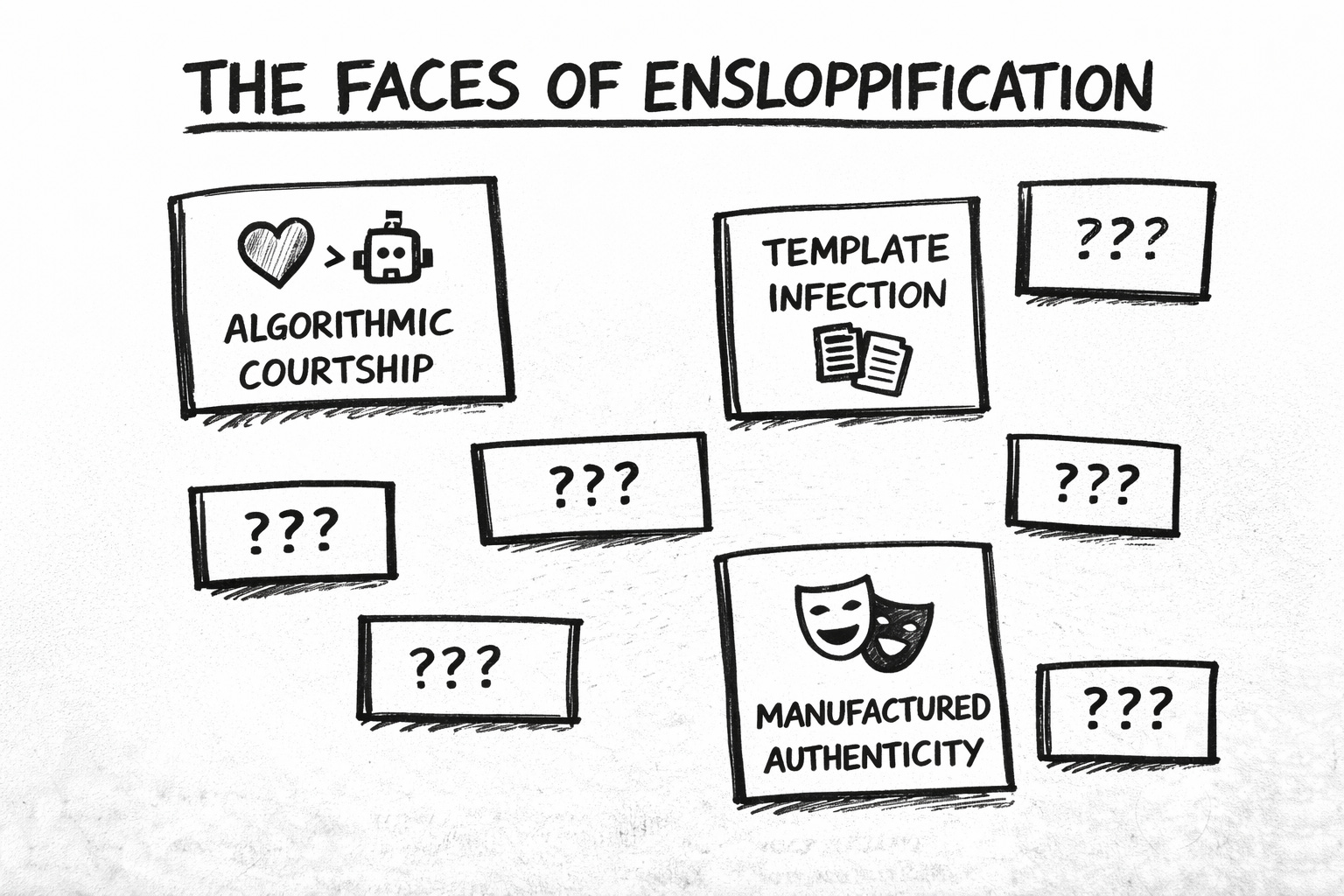
Nine distinct behaviors. Nine heads of the same beast. Algorithmic Courtship. Template Infection. Manufactured Authenticity. Credibility Theater. The Recursive Collapse. Stop one and two others emerge.
Tomorrow, I’m naming its heads.
The platforms are rotting from above. The question isn’t whether they’ll take us with them.
It’s whether we were already rotting before they started.
Tomorrow: The Nine-Headed Hydra of Ensloppification. The complete taxonomy of slop-creating behaviors… and the uncomfortable conversation about which heads you’ve been feeding.
What’s the most egregious example of ensloppification you’ve seen in the wild? Screenshot it. Reply with it. Let’s build a gallery of shame together. I’ll start tomorrow with my own contributions to the slop pile.
Crafted with love (and AI),
Nick “Ensloppification Patient Zero” Quick

PS…Tomorrow’s post names the heads. Subscribe if you want to see which ones you’ve been feeding.
“Enshittification squeezes down, ensloppification pushes up” is the cleanest description I have seen of why everything starts to feel like the same ghostwriter with the same six templates. AI is not the root cause. It just removed the last remaining constraint: effort. Spot on.
One important nuance though: ensloppification by itself is not automatically bad. It is a forcing function.
When artifacts get cheap and plausible, production stops being the hard part. The hard part becomes discernment: knowing what to trust, what to keep, what to ship, and who will own the consequences.
The part that is bad is the legibility collapse that follows when incentives reward artifact volume over owned judgment. Provenance disappears. Intent disappears. The internet gets louder while getting less accountable.
What decides which path we get is incentives and interface. Slop can push people toward sharper standards, or toward resignation. The failure mode is newstainment: tired people stop checking, vibes get treated as truth, and the epistemic floor drops.
My countermeasure is boring and unfashionable: standards. Not purity tests. Standards that force traceable thought.
No scope, no claim. State premises. Show method. Provide evidence. Name tradeoffs. Include a disproof check.
If slop is the flood, discernment has to become the boat.
Artifacts are cheap. Judgment is scarce.
Thank you for this! I’ve had this creepy feeling for the past 5 years about all things online and finally I can call it what it is: ensloppification