
Adequate Is the New Enemy
Bad is easy. Adequate is what buries you.

I almost published something last week that I can’t remember.
That’s not a figure of speech. I literally cannot recall what it was about. I wrote it by hand. I painstakingly edited it. I even ran it through the Voiceprint checks. Everything passed. Green lights across the board.
I scheduled it. Then I sat there staring at the publish button like it owed me some goddammed moolah.
Nothing was wrong with it. That was the problem. Nothing was wrong, and nothing was right, and nothing was anything at all. It was content-shaped. Newsletter-flavored. A perfectly adequate block of text that would’ve filled Thursday’s slot and vanished into the void like every other piece of forgettable content clogging the interwebz.
(I deleted it. Ate a tofu sandwich. Couldn’t tell you what either tasted like.)
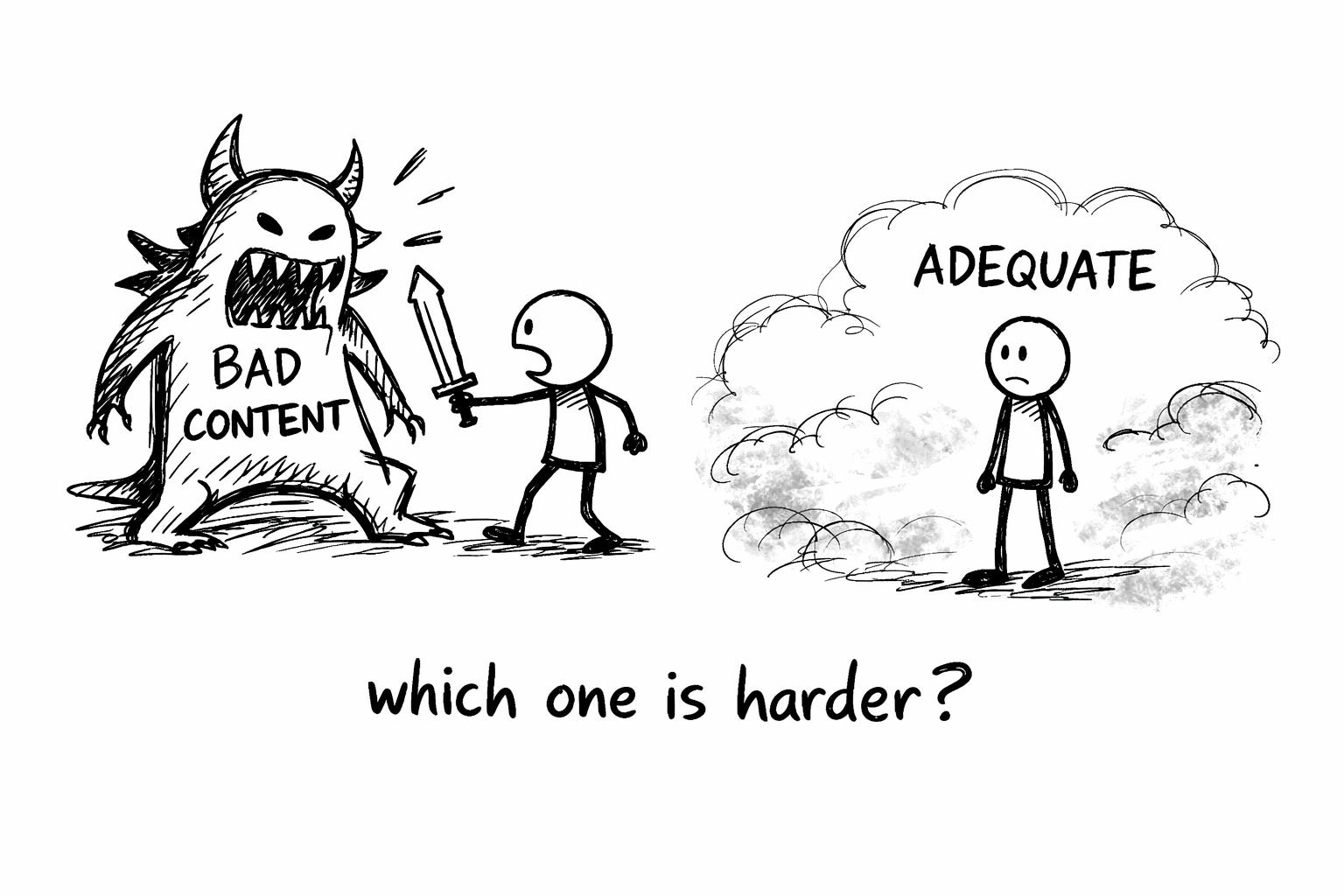
Here’s what I’ve realized: the old enemies were easy.
Robotic phrasing? Spot it. Cut it. Gone.
Smooth-but-generic polish? That telltale AI sheen where everything sounds professionally lobotomized? You learn to spot it. You build detectors. You run your VAST layers and find the drift.
Those problems have tells. They announce themselves. They give you something to push against.
Adequate doesn’t announce anything.
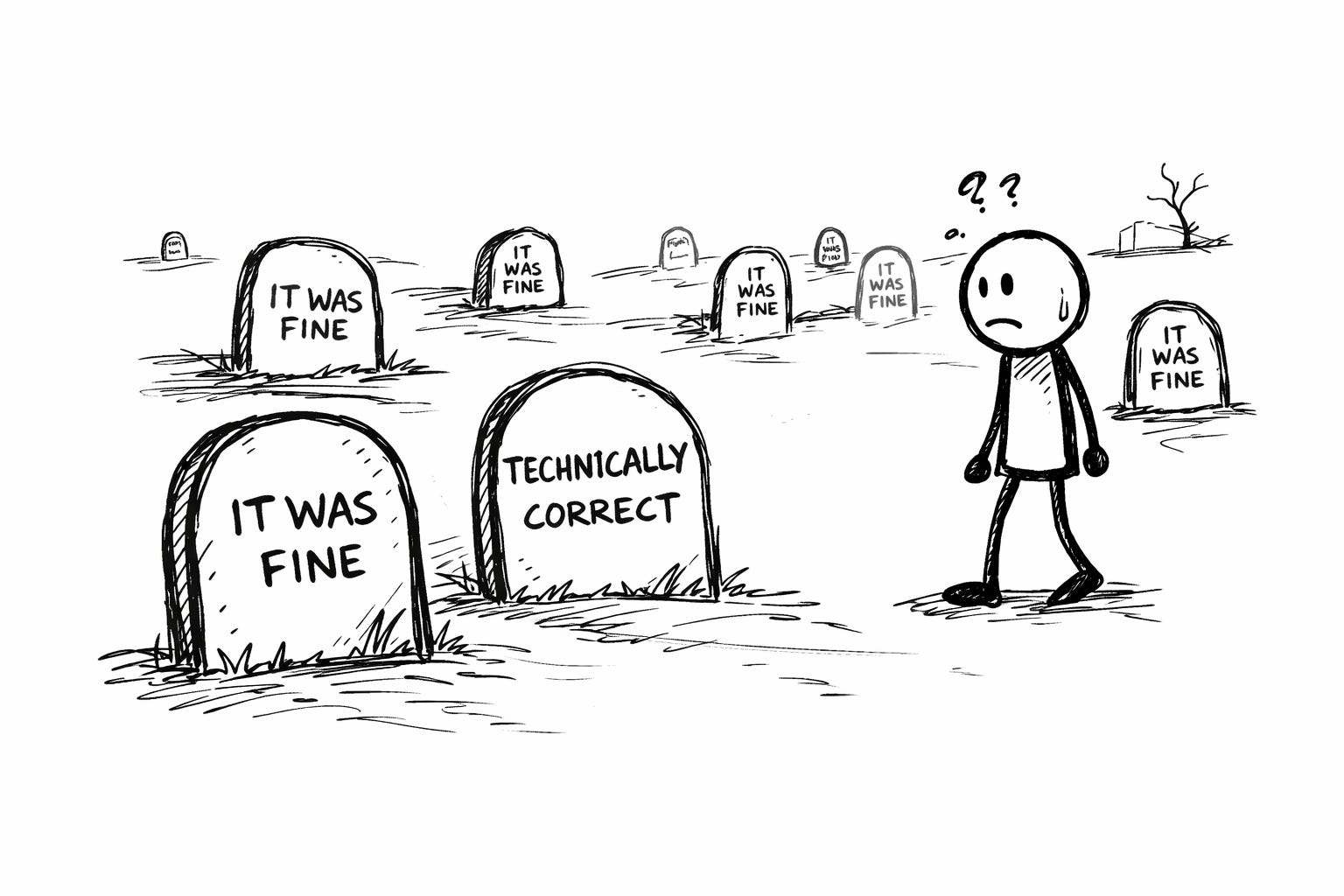
Adequate just squats in your drafts folder. Technically correct. Functionally useless. Daring you to find a reason to put it out of its misery. (You won’t. It knows.)
Bad content is a fire alarm. Adequate content is carbon monoxide. One gets your attention. The other kills you slowly while you wonder why you’re so f’in tired.
(I’m really selling the newsletter life, I know.)
The calculus is brutal: bad has a fix. Make it better. Clear path. Obvious problem, obvious solution.
Adequate has no fix because it doesn’t register as broken. You can’t debug “fine.” You can’t optimize “passable.” You can’t prompt-engineer your way out of “Sure, I guess this is fine.”
Adequate passes the tests. That’s the whole damn problem.
I went back through my drafts folder last week. Not the killed drafts (those are mercy killings, those bitches had it coming). The published ones. The stuff that made it out into the world with my name on it.
Some of it was good. Some of it I’m still proud of.
And some of it was adequate.
Posts that hit publish, filled the slot, technically delivered value, and left absolutely no impression on anyone… including me. Content I created that I barely remember creating. Work that existed and then stopped existing in anyone’s mind the moment they scrolled past.
(The content equivalent of cuddling… out of obligation.)
So what do you do about it?
I don’t have a framework. (Yet.) What I have is a question I’ve started asking before I hit publish:
Would I screenshot this and send it to someone?
Not “is this correct.” Not “does this pass the checks.” Not “will this fill Tuesday’s slot.”
Would I actively, voluntarily, without being asked, send this to a real human being I respect and say: “you need to read this”?
If the answer is no, it might be adequate. Adequate isn’t good enough anymore.
(This test has murdered more drafts in the last two weeks than my entire quality control system did in the last six months. I’d ask what that says about me, but I don’t want the answer.)
Here’s why I start drinking earlier nowadays.
The slop factories aren’t producing bad content anymore. They figured that out. The robots learned to avoid the obvious tells. No more “delve.” No more em-dash stew. No more uncanny valley phrasing that screams “a machine wrote this.”
They’re producing adequate content now. Mountains of it. Technically correct. Professionally passable. An endless flood of fine that fills every feed, every inbox, every search result.
And if you’re not careful, your content starts blending into that pile. Not because it’s bad. Because it’s not good enough to escape the gravitational pull of fine.
Bad stands out. Bad gets noticed (for the wrong reasons, but still).
Adequate disappears. The internet swallows it whole and doesn't even belch.
I used to think the opposite of slop was quality.
Now I think the opposite of slop is memorable. Work that crawls into someone's noggin and starts paying rent. Content that makes people feel something, even if that something is “I disagree with this asshole.”
Adequate doesn’t make anyone feel anything. It’s faking it. You both know. Neither of you says anything.
🧉 When’s the last time you hit publish and felt something other than relief that it was over?
One word to describe how it felt. I’ll start: Off-leash.
Crafted with love (and AI),
Nick "Fine Is A Four-Letter Word" Quick

PS… I write about this daily for creators who refuse to be background noise. Subscribe, and send this to someone who’s been producing “fine” for so long they forgot what “holy shit” feels like.
PPS… The first step to escaping adequate is knowing your own voice well enough to notice when it’s missing. The Voiceprint Quick-Start Guide helps you document that foundation. Get it here:
This reminds me of a quote Dan Gilbert, chairman of Rocket Companies used to say a lot:
“Shit is the default setting.”
Basically, people are often comfortable with adequate (or worse), and that’s the root of so many things we can improve in the world.
Or a nicer version from my Godmother:
“We rise to the level of our own ignorance”
This reminded me of a funny situation from a few weeks ago:
During the holidays, I read two romance fantasy books in a row, both by famous authors.
One was *very* poorly written but sticky AF. You need to keep reading (although at times you’re like ‘I can’t stand seeing this adjective for the umpteenth time’) just to figure out how things develop.
The other book was well written—nothing I’d call beautiful prose, but decent. However, it was incredibly dull.
All throughout January, I kept asking people around me: ‘Which is worse: to be a bad writer who writes sticky stuff, or to be a decent writer who writes boring stuff?’. People’s responses were very diverse. 😁
Now back to your article: I sometimes feel the need to put something out there just for the sake of ticking the box, but then I remember my fear of being a ‘meh’ writer. In those moments, I try to come back to the fun in writing, or to the wish to be genuinely useful & of service (e.g. when I’m writing a walkthrough for something). Still, the fear of ‘meh’ is always there. :)